From Scorekeeper to System Designer
Why AI Belongs to the CFO

For decades, finance was defined by accuracy, caution, and compliance. The CFO kept the books straight, satisfied regulators, and made sure the balance sheet stayed intact. It was an essential role, but no one confused the CFO’s work with strategy.
That story began to change with Sarbanes-Oxley. The law didn’t just increase compliance requirements. It taught finance how to prove trust: documented controls, evidence trails, and personal certification of results. Then came cloud computing, which gave finance reach across the enterprise, and machine learning, which showed that algorithms could spot patterns faster than humans.
Now generative AI is pushing finance into a different league. It is no longer about recording the past. It is about shaping decisions in real time. And it is a responsibility that falls squarely on the CFO.
SOX habits become an AI advantage
Most CFOs don’t think of themselves as technologists, but they already have the habits needed to govern AI. SOX forced finance to build muscles around evidence, review, and accountability. Those same muscles apply when models are drafting commentary, flagging anomalies, or running scenarios.
Three practical moves:
Treat prompts and outputs like workpapers. Keep a log, version them, and tie them to the reporting cycle.
Require human sign-off before AI-generated commentary moves up the chain.
Write short “suitability memos” that explain what a model is used for, what its limits are, and when it needs to be re-evaluated.
The benefit is speed without fragility. Finance gets the cycle-time gains of AI but retains the credibility that regulators and auditors demand.
Deterministic tools vs. probabilistic AI
ERP, BI, and RPA made processes faster and more standardized. Given the same inputs, they always produced the same outputs.
Generative AI is different. It generates narratives, proposes drivers, and surfaces scenarios that were never explicitly programmed. That creates leverage for analysts and shortens reporting cycles. It also changes the oversight question.
It is no longer “did the job run?” The real test is “is this output fit for purpose and explainable?”
Explainability in practice means a clear path from inputs and assumptions to an output that a reviewer can challenge. You don’t need model internals to provide that. You do need clear data scope, rationale, and reviewer notes.
Why the CFO makes the call
The CIO manages infrastructure and security. Important work, but not fiduciary risk.
When AI touches forecasting, variance analysis, cash flow, or disclosures, the stakes change. The CFO owns the data, the outcomes, and the signature on the numbers. That means only finance can decide whether an AI-assisted output belongs in board materials or SEC filings.
The division of labor is simple. The CIO protects the pipes. The CFO defines acceptable use, sets reviewer workflows, and maps outputs back to the control framework.
The pressure stack
CFOs are feeling pressure from every side:
Boards want faster cycles, real-time scenarios, and stronger narratives.
Global operations create multi-entity, multi-currency complexity that only automation can tame.
Finance teams are stretched thin and younger analysts expect modern tools, not manual reconciliations.
Regulators and auditors are already asking how AI outputs are validated, logged, and reviewed.
Put together, these forces make the case for CFO leadership clear. Waiting is its own kind of risk.
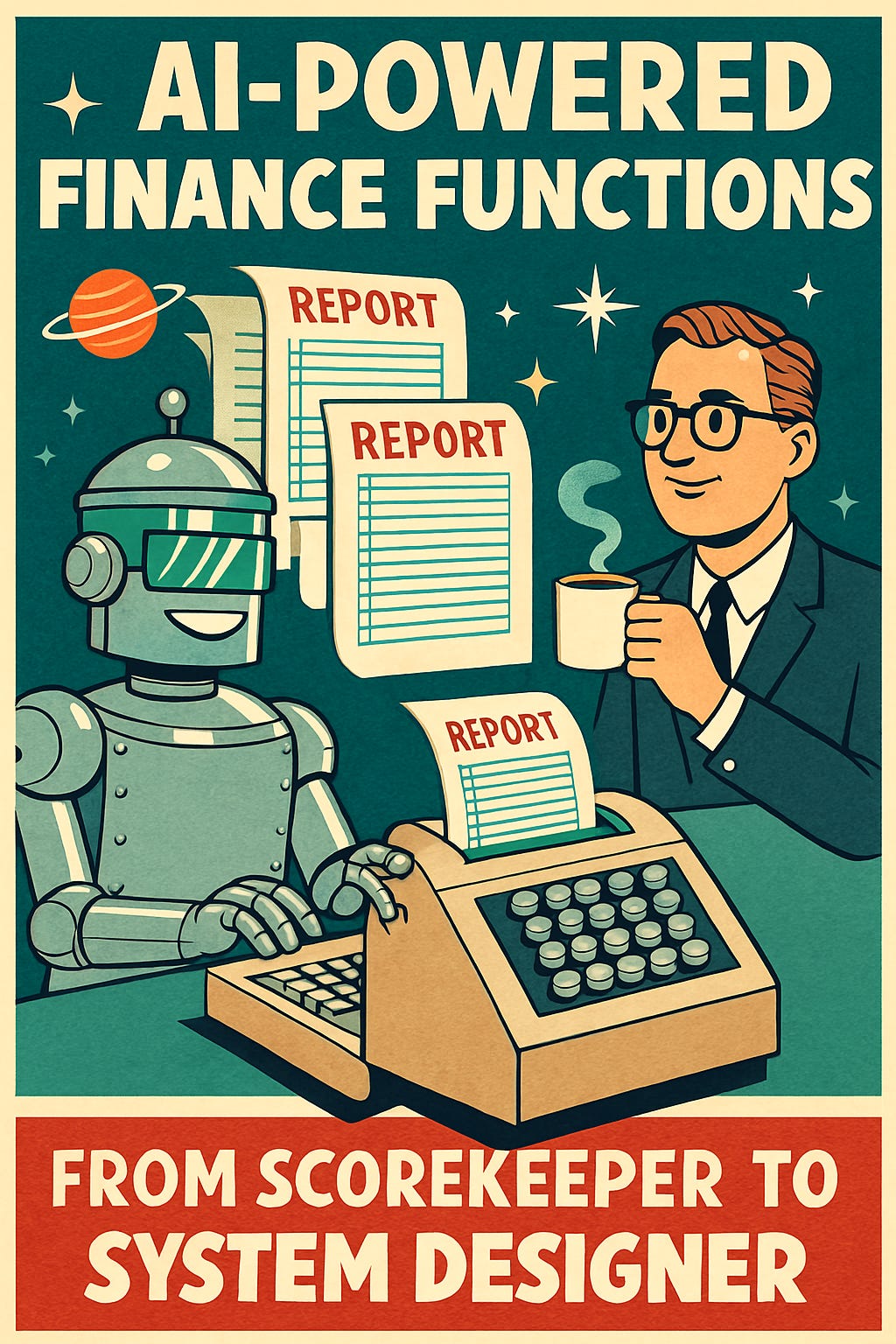
Generative AI is not a faster typewriter. With the right guardrails, it becomes a repeatable production line for decision-quality insights.
Monday-morning moves
The best approach is to start small and make it defensible.
Build an AI Evidence Pack for one pilot. Variance commentary is a good place to start. Include the prompt, dataset, model version, raw output, edits, reviewer sign-off, and a short suitability memo.
Run three sprints over 90 days.
Sprint 1: Draft variance narratives with human review. Track cycle-time saved.
Sprint 2: Add anomaly detection on GL and AP. Institute a monthly suitability check.
Sprint 3: Generate rolling scenarios for the CFO deck. Track decision latency reduction.
Define what good looks like. Publish cycle-time targets, reviewer SLA, and error thresholds to your team and audit committee.
Lock a CFO–CIO RACI. Spell out who owns data eligibility, deployment, logging, and incident response. Put it in writing.
The 90-day outcome
Close-to-board cycle shrinks from ten days to five or six.
Twenty to thirty percent of analyst hours shift from reconciliation to forward-looking analysis.
Internal audit signs off that your Evidence Pack aligns with controls.
Finance showcases before-and-after examples, turning skeptics into advocates.
Bottom line
Generative AI is not a faster typewriter. With the right guardrails, it becomes a repeatable production line for decision-quality insights.
CFOs are already responsible for trust, data, and outcomes. That makes them the natural leaders of AI in the enterprise. Start with one pilot, prove the cycle-time gain, and build from there.
Unlock the full operating model, templates, and prompts: